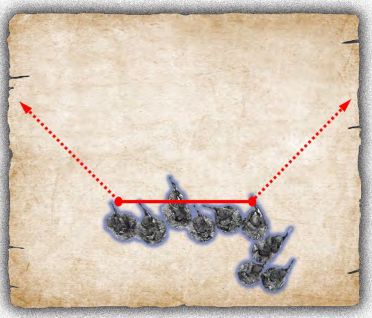
An activated Unit can target any visible enemy that is in its Arc of Fire. Any figure in the firing Unit that has a Line of Sight to the enemy can fire at the target Unit. If only some figures in a Unit can see the target, only those figures can fire.
Where some figures in a Team have their Line of Sight blocked by friendly figures, they cannot fire through them. Where an LMG Team of two or more figures is firing, the gunner and at least one other figure must have Line of Sight to be able to fire at the target Unit.
No Unit can ever fire through another friendly Unit. The firer’s Line of Sight must not pass within 2" of another friendly Team, unless that Team is part of the same Section, in Hard Cover, such as a building, or an armoured vehicle. An enemy Team cannot be targeted if a friendly Unit is within 4" of it.
A Unit which has its frontage restricted, such as when firing down an alley or narrow defile, or when simply restricted by the space it occupies, fires with one figure for each inch of Unit frontage.
Teams on a higher level, such as a hill, in an upper storey of a building or the turret of an AFV, can fire over the heads of intervening friendly Units if they have a clear Line of Sight to the target. Flamethrowers may not do this.
If the target reacts by using Chain of Command Dice or Points, this happens before any Firepower Dice are rolled.
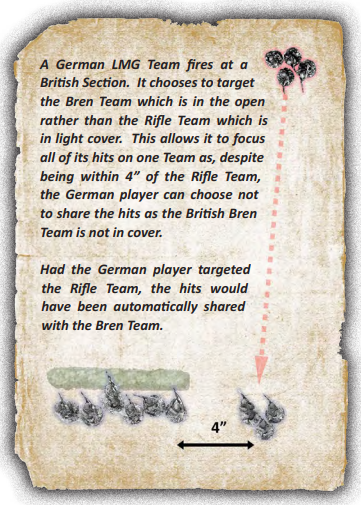
If the target Team has another friendly Team within 4" but in better cover, the firer can choose to concentrate all fire on the Team with less cover, or they can divide the fire between both. Where the target Team is in better cover than the other Unit, the hits must be divided between them.
Where only some figures in a Team can fire, the full effect of Shock will be applied against the part of the Team which is firing. The remaining total is the number of Firepower Dice rolled.
| Range | To Hit |
|---|---|
| Close | 4 to 6 |
| Effective | 5 and 6 |
Total up the number of hits. Where more than one Team is the target, divide the hits equally between them. If the target Team is in the Open, any odd hits are allocated by the firer. If the target Team is in cover, any odd hits will be allocated by the target player. No more than one "odd" hit may be allocated to any one Team.
The targeted player rolls a D6 for each hit.
| Cover | Miss | Shock | Kill |
|---|---|---|---|
| Open | 1, 2 | 3, 4 | 5, 6 |
| Light | 1, 2, 3 | 4, 5 | 6 |
| Hard | 1, 2, 3, 4 | 5 | 6 |
The targeted player rolls a D6. A roll equal to or less than the number of figures that were killed means a Leader is hit. A hit on a Leader reduces the number of kills on the figures in the Unit by one.
Potentially, a Leader can be hit more than once in a Phase. In the unusual event of a Unit losing six or more figures killed by firing, the Leader is automatically hit once and rolls for any additional kills above six. For each hit on the Leader, roll 1D6 to see the effect.
| Roll | Effect |
|---|---|
| 1 | The Leader is killed |
| 2,3 | Leader is Stunned |
| 4,5,6 | The Leader is Wounded |
| In action |
|---|
| A Soviet LMG Team is firing on a German Section in
Light Cover, behind a hedge, 19" away. The German
player has thrown a smoke grenade which masks
the target Unit.
The Soviets roll six Firepower Dice. At 19" they are at Effective Range so normally hit on a 5 or 6. However, the smoke reduces that by -1, so the Soviets will only hit on 6’s. The German player could have fired Suppressing Fire at the Soviet LMG Team to add a further -1, but this would actually have had no effect as firing always hits on a 6. Remarkably, the Soviet player rolls 1, 2, 6, 6, 6, 6. Four hits. As the German Section is comprised of two Teams within 4" of each other and both are in the same level of cover, the four hits are shared between both Teams; two hits each. The German player rolls 2D6 for the Rifle Team: 2 and 5. As they are in Light Cover the 2 is a miss and the 5 is one point of Shock. This is noted on the Team with a small D6. The LMG Team now rolls 2D6, rolling 4 and 6. In Light Cover, the 4 is a point of Shock and the 6 is a kill. A pretty effective round of fire, especially as a Leader could be hit. The player checks for that immediately. |
A Unit with a Stunned Leader may not move At the Double. If obliged to retreat from a Close Combat, the Leader will move with them. If the Unit Breaks due to fire or Close Combat, the Leader will be left where they are and captured if contacted by the enemy while still Stunned. Take a Force Morale Test for a Leader Killed.
Once the Turn ends, the Stunned Leader recovers and may act as normal when subsequently activated, with no reduction in Orders they can issue. If separated from their Unit, they must move to rejoin them when activated.
Where weapons such as anti-tank guns have a gun-shield to protect the crew, this improves their cover by one level, to a maximum of Hard Cover, when fired at from an enemy in their front 180 degrees.
To fire at a visible target in a building, the firer must be within the same 90 degree arc measured from the building. The target must be within 4" of the door or window.
A Unit inside a building firing at an enemy Unit on the same floor treats them as a target in Light Cover.
Larger buildings should be broken down into multiple sectors, roughly 6" square, each being treated as a separate building, with firing between two adjacent sectors counting the target as in Hard Cover.
Guns and AFVs can fire at any point on a visible building, hitting any enemy inside even without Line of Sight to the Unit. For large buildings broken down into sectors, the sector of the building occupied by the target must be visible to the firing Unit.
In addition to hits caused on the passengers, any 6’s rolled when firing at Transport Vehicles causes a point of Shock on the vehicle. If the vehicle is in cover, the first 6 rolled by the firer will not cause Shock. See Section 4.2.1, Shock on Transport vehicles.
Troops in APCs manning exposed weapons positions, such as an LMG on a halftrack, can be fired on and treated as in Hard Cover.
LMG, MMG and HMG Teams may attempt to drive off armoured vehicles with fire. See Section 16.4.5, MGs Against Armoured Vehicles.
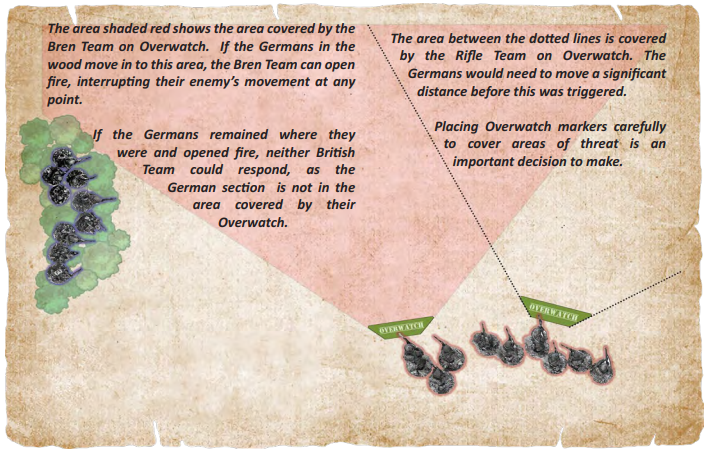
The Unit on Overwatch can fire at any time when an enemy Unit moves in the area covered by Overwatch. A Unit on Overwatch always Fires for Effect.
When an enemy Unit in the area covered by Overwatch remains stationary and fires, the Unit on Overwatch returns fire after the enemy Unit completes their shooting.
A Unit on Overwatch may choose not to react to an enemy and remain on Overwatch.
To be able to fire Suppressing Fire, the Team firing must be able to fire with three or more Firepower Dice. No dice are rolled when firing Suppressing Fire. A Unit firing Suppressing Fire can do nothing else in their activation.
Suppressing Fire is targeted against either a visible enemy infantry or Support Unit or against a 4.5" frontage of unoccupied terrain which would offer cover should an enemy appear or move there. Suppressing Fire cannot be fired at vehicles or against open terrain. It may be fired into Smoke. A Suppressing Fire marker is placed immediately in front of the target Unit or area of terrain.
Suppressing fire extends 4.5" beyond the Suppressing Fire marker. Its effects are applied to any enemy Unit moving, firing or deploying in that area.
To fire Suppressing Fire at a building, the firing Unit must be within the 90 degree arc of the building’s face. A Team firing Suppressing fire at a building targets up to two adjacent floors.
Where a Section is not broken down into Teams, it must have sufficient figures to be able to generate six or more Firepower Dice. It may fire Suppressing Fire against one enemy Unit or an unoccupied area of cover with a 9" frontage
A Unit that spends any of its movement in an area covered by Suppressing Fire cannot move At the Double in that Phase.
Suppressing Fire lasts for the current Phase and the next Phase. If a Turn ends, the effect of Suppressing Fire ends immediately. Firing Suppressing Fire at a Unit that is already under Suppressing Fire will not increase its effect.
| In action |
|---|
| A German Panzer Grenadier Section deploys facing
a small copse that contains a Soviet Jump-Off Point.
It’s clearly a threat, so the Junior Leader issues
one Order to get his first LMG Team to put down
Suppressing Fire. A Suppressing Fire Marker is
placed in front of the Soviet Jump Off Point. It’s at
Effective Range, so even if the Soviets can deploy
into that area, they’ll only be hitting on a 6 if they
fire.
The second LMG Team in the Section deploys 6" forward in a Tactical stance, thereby improving its chances of survival should the enemy fire on them. In their next active Phase, the second LMG Team puts down Suppressing fire while the first Team moves forward. They have three Chain of Command Points in-hand, so move At the Double, safe in the knowledge that they can Hit the Dirt if the Soviets deploy and open fire. If they had no Chain of Command Points, Tactical movement would be slower but equally effective at protecting the Unit. |
For grenades against armoured vehicles, see Section 16.4.6, Hand Grenades Against APCs and Section 16.4.7, Hand Grenades Against AFVs.
Any figure in the Unit that the Leader is attached to can throw the grenade. Grenades may be thrown at a Unit that cannot be seen, such as when a high obstacle is between the thrower and the target.
If the target Unit is in the open or Light Cover, they must be a minimum of 4" from the throwing Unit. Grenades can be thrown at closer targets if they are in, or behind, Hard Cover, or if the grenade is being thrown, or "posted", into an open-topped vehicle or building.
Grenades used against Fortifications must enter an aperture to be effective, either being thrown in or by being "posted", to have any effect.
Roll 2D6 for each grenade thrown. To hit, the total rolled must equal or exceed the Target Roll amount which is based on the distance to the target. If the total rolled is less than the target roll, the grenade misses and has no effect
| Target | Target Roll |
|---|---|
| In the Open or behind a Minor Obstacle | Distance in inches |
| Behind a Medium Obstacle, e.g. large window or door | Distance in inches +1 |
| Behind a Major Obstacle, e.g. small window, upper window | Distance in inches +2 |
| Behind a High obstacle or in a bunker or open topped vehicle | Distance in inches +3 |
| Post grenade | 3 or more |
| Subtract -1 from the throw if a target vehicle is moving Flat Out, or the grenade is thrown through smoke | |
Hand grenades roll for the effect of all hits as though the target is in the Open.
When firing at a new target, roll one Firepower Dice per rifle grenade. In subsequent Phases, two Firepower Dice will be rolled if the target has not moved more than 6" from the last position it was fired on. Rifle Grenades reduce cover by one level. Rifle Grenades apply the Storm of Steel Bonus.
For Rifle Grenades firing against open topped AFVs, see Section 16.4.8, Light Mortars and Rifle Grenades Against Armour.
The player places an aiming point up to 12" away and rolls 2D6. The total rolled is the distance the grenade is thrown. Place a 3" round ball of smoke that distance in inches in line with the aiming point.
A Light Mortar firing at a Unit it can see, or that a friendly Leader within 6" can see, rolls its Firepower Dice, hitting as at Close Range.
A Light Mortar firing at a Unit it cannot see but which can be observed by any friendly Leader, rolls its Firepower Dice, hitting as at Effective Range. Light Mortar Effect Light Mortars always Fire for Effect; they do not fire Suppressing Fire. Light mortars reduce a target’s cover by one level. Light mortars have the Storm of Steel Bonus.
For Light Mortars firing against open topped AFVs, see Section 16.4.8, Light Mortars and Rifle Grenades Against Armour.
| Roll | Mortar Smoke Deployment |
|---|---|
| 1 | Round lands 6" to the left |
| 2 | Round lands 6" to the right |
| 3 | Round hits target if there is Line of Sight Round lands 6" beyond aiming point if no Line of Sight |
| 4 | Round hits target if there is Line of Sight Round lands 6" short of aiming point if no Line of Sight |
| 5 - 6 | Round hits target |
The smoke deployed by Light Mortars blocks Line of Sight and cannot be fired through.
Note: See the National Arsenals for which mortars can fire smoke.
To fire an Infantry-portable Anti-Tank weapon, such as a Bazooka or Panzerfaust, against a target that is not an armoured vehicle, the target must be in range and a Senior Leader within Comm and Range of the Unit firing must use an Order.
To hit, roll the number of H.E. Firepower Dice shown on the National Arsenal. If within the weapon’s first two range bands, firing is done at Close Range. Above that, it is Effective Range. The Storm of Steel Bonus applies. Infantry anti-tank weapons reduce the target’s cover by one level.
The PIAT, with no back-blast, and the Panzerfaust 30, with a limited back-blast, can fire from inside any building.